

Arthur Besse
cultural reviewer and dabbler in stylistic premonitions
- 26 Posts
- 184 Comments
Arthur Besse@lemmy.mlto
Programmer Humor@programming.dev•Well. That escalated quicklyEnglish
5·2 days agoIdk it works for me.
I don’t think there is any possible value for the
signvariable which would make that if statement do anything other than raise aTypeError.Also
"8:00:00" > "10:00:00"but
"08:00:00" < "10:00:00". comparing timestamps as strings is weird but actually works, as long as the hour is zero-padded :)the problem with this code is that
&(bitwise AND) has higher operator precedence thanand==do, so it is first trying to bitwise AND"10:00:00"withsign(which i’m assuming would also be a string) and that will always raise aTypeError.to do what the author appears to have intended to do, they would either need use parenthesis around both comparisons to actually bitwise AND their results, or (better) to use the boolean AND operator (
and) instead of&.The boolean
andoperator is the right tool for the job, and since it is lower precedence it also wouldn’t require that any parenthesis be added here.
Arthur Besse@lemmy.mlto
Programmer Humor@programming.dev•Well. That escalated quicklyEnglish
231·3 days agoTypeError: unsupported operand type(s) for &: 'str' and 'str'
So in summary. You’re right. Sealed sender is not a great solution. But
Thanks :)
But, I still maintain it is entirely useless - its only actual use is to give users the false impression that the server is unable to learn the social graph. It is 100% snake oil.
it is a mitigation for the period where those messages are being accepted.
It sounds like you’re assuming that, prior to sealed sender, they were actually storing the server-visible sender information rather than immediately discarding it after using it to authenticate the sender? They’ve always said that they weren’t doing that, but, if they were, they could have simply stopped storing that information rather than inventing their “sealed sender” cryptographic construction.
To recap: Sealed sender ostensibly exists specifically to allow the server to verify the sender’s permission to send without needing to know the sender identity. It isn’t about what is being stored (as they could simply not store the sender information), it is about what is being sent. As far as I can tell it only makes any sense if one imagines that a malicious server somehow would not simply infer the senders’ identities from their (obviously already identified) receiver connections from the same IPs.
Sure. If a state serves a subpoena to gather logs for metadata analysis, sealed sender will prevent associating senders to receivers, making this task very difficult.
Pre sealed-sender they already claimed not to keep metadata logs, so, complying with such a subpoena[1] should already have required them to change the behavior of their server software.
If a state wanted to order them to add metadata logging in a non-sealed-sender world, wouldn’t they also probably ask them to log IPs for all client-server interactions (which would enable breaking sealed-sender through a trivial correlation)?
Note that defeating sealed sender doesn’t require any kind of high-resolution timing or costly analysis; with an adversary-controlled server (eg, one where a state adversary has compelled the operator to alter the server’s behavior via a National Security Letter or something) it is easy to simply record the IP which sent each “sealed” message and also record which account(s) are checked from which IPs at all times.
it would more likely be an NSL or some other legal instrument rather than a subpoena ↩︎
sealed sender isn’t theater, in my view. It is a best effort attempt to mitigate one potential threat
But, what is the potential threat which is mitigated by sealed sender? Can you describe a specific attack scenario (eg, what are the attacker’s goals, and what capabilities do you assume the attacker has) which would be possible if Signal didn’t have sealed sender but which is no longer possible because sealed sender exists?
In case it wasn’t clear, I’m certainly not advocating for using WhatsApp or any other proprietary, centralized, or Facebook-operated communication systems 😂
But I do think Facebook probably really actually isn’t exploiting the content of the vast majority of whatsapp traffic (even if they do turn out to be able to exploit it for any specific users at any time, which i wouldn’t be surprised by).
“Anonymity” is a vague term which you introduced to this discussion; I’m talking about metadata privacy which is a much clearer concept.
TLS cannot prevent an observer from seeing the source and destination IPs, but it does include some actually-useful metadata mitigations such as Encrypted Client Hello, which encrypts (among other things) the Server Name Indicator. ECH a very mild mitigation, since the source and destination IPs are intrinsically out of scope for protection by TLS, but unlike Sealed Sender it is not an entirely theatrical use of cryptography: it does actually prevent an on-path observer from learning the server hostname (at least, if used alongside some DNS privacy system).
The on path part is also an important detail here: the entire world’s encrypted TLS traffic is not observable from a single choke point the way that the entire world’s Signal traffic is.
Many people have reverse-engineered and analyzed whatsapp; it’s clear that they are actually doing e2ee. It is not certain that they don’t have ways to bypass it for targeted users, and there is currently a lawsuit alleging that they do, but afaik no evidence has been presented yet.
Signal protocol is awesome for privacy, not anonymity
The “privacy, not anonymity” dichotomy is some weird meme that I’ve seen spreading in privacy discourse in the last few years. Why would you not care about metadata privacy if you care about privacy?
Signal is not awesome for metadata privacy, and metadata is the most valuable data for governments and corporations alike. Why do you think Facebook enabled e2ee after they bought WhatsApp? They bought it for the metadata, not the message content.
Signal pretends to mitigate the problem it created by using phone numbers and centralizing everyone’s metadata on AWS, but if you think about it for just a moment (see linked comment) the cryptography they use for that doesn’t actually negate its users’ total reliance on the server being honest and following their stated policies.
Signal is a treasure-trove of metadata of activists and other privacy-seeking people, and the fact that they invented and advertise their “sealed-sender” nonsense to pretend to blind themselves to it is an indicator that this data is actually being exploited: Signal doth protest too much, so to speak.
100% of options funded by western governments
One of their four, SimpleX, is not funded by western governments (…but it instead has some venture capital 🤡)
a wifi access point that gets online via a cellular network is called a mobile hotspot, regardless of if it’s running on a phone or a dedicated router device
huh? mobile hotspot is double-bad
thank you OP for allowing me the opportunity to read this entire image here on lemmy prior to seeing the creator’s mastodon username, so that i could believe it was real for a minute :)
(for anyone unfamiliar with it, check out her other amazing work…)
also ping and thankyou to @NanoRaptor@bitbang.social (in case mentions on lemmy notify mastodon users?)
now do gtkmm
Why not just use proton?
A few of the many reasons not to use Proton:
- their e2ee is snakeoil (see my comment here about why - but tldr it requires completely trusting them and if you completely trust them you wouldn’t need e2ee, the point of e2ee is to avoid needing to trust the service provider)
- their server-side code is closed-source
- they’re a freemium service which can and does arbitrarily decide to start charging for previously-free features
- they’ve suspended a number of users who they should not have
- their CEO is a trump fanboy.
…
Its Swiss based.
You know who else was Swiss based? 🙄
Not sure about purism but I think its US so avoid it like a plague.
I don’t know enough about Purism to endorse them but afaict they don’t have any of the above problems.
Purism’s e2ee is PGP; you can use their service via their client software or whatever other client you want, and can communicate with people who are using different implementations with different mail providers. I don’t see any mention of them even offering webmail but I expect that if they do they would probably offer PGP there using a browser extension instead of having extremely-impractical-to-verify-before-running-it js code being sent anew from the server every time you load the page (which is how Proton’s webmail works, and also what they offer for non-Proton users to receive mail encrypted using their nonstandard encryption).
I’d rather have US legal jurisdiction and credible e2ee which doesn’t allow the operator to trivially circumvent it for targeted users than to have Swiss jurisdiction and snake oil.
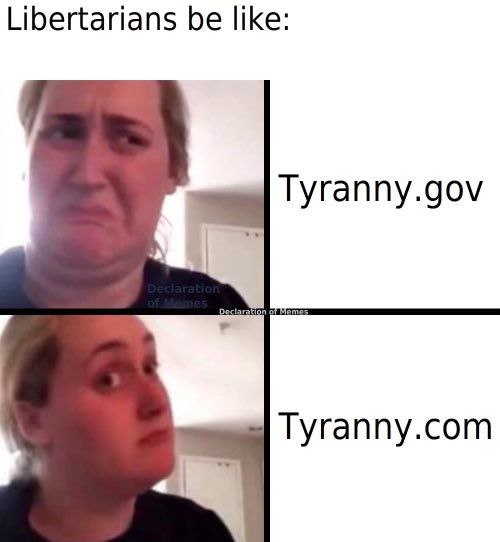
Not sure what you are saying. With the order of the meme reversed it doesn’t make it obvious which point is supposed the clearer point of view…
It isn’t reversed compared to how this meme format is usually used: the glasses-on image is on the bottom, and associated with the viewpoint OP is saying is correct/better.
If one hasn’t seen (or has forgotten) the film, this is the way that makes sense, since glasses (generally) improve the wearer’s vision.
This meme’s canonical format is however in fact at odds with the actual scene in the 2002 film:

A related meme form which doesn’t have this ambiguity is the much older they live sunglasses - here the position of the two images are used less consistently (though as with peter parker, usually glasses-on is the lower one) but the glasses being on showing the truth actually fits with how it is in the film.
corollaries to Hanlon’s razor include:

Arthur Besse@lemmy.mlMto
Linux@lemmy.ml•Can you use Linux today without the terminal?English
32·22 days agoDoes anything provide a similar experience to Arch’s amazing AUR
I am not aware of any software distribution service with a comparable experience (massive userbase with zero vetting for uploaders) as Arch’s amazing AUR - if you are looking for a way to distribute malware to many unsuspecting people (who’s friends think they’re hackerman), it’s really unparalleled. (😢)
To your primary question, yes, many people do successfully daily drive various Linux distros without ever opening the terminal. 🙄
Arthur Besse@lemmy.mlto
Privacy@lemmy.ml•I'm tired of LLM bullshitting. So I fixed it.English
8·24 days ago


this post is a screenshot of https://news.lettersofnote.com/p/oh-my-god-how-i-do-hate-species-and
see also https://news.lettersofnote.com/p/i-loathe-i-abhor-the-sea-and-all
and https://www.darwinproject.ac.uk/ (where you can search and read the full text of over 15,000 of Darwin’s letters)